
Manufacturing & Quality Control
Peptide Purity vs Content: Reading a COA
Research Use Only (RUO). Products and information are intended exclusively for qualified laboratory research. Not for human consumption, clinical treatment or diagnostic use.
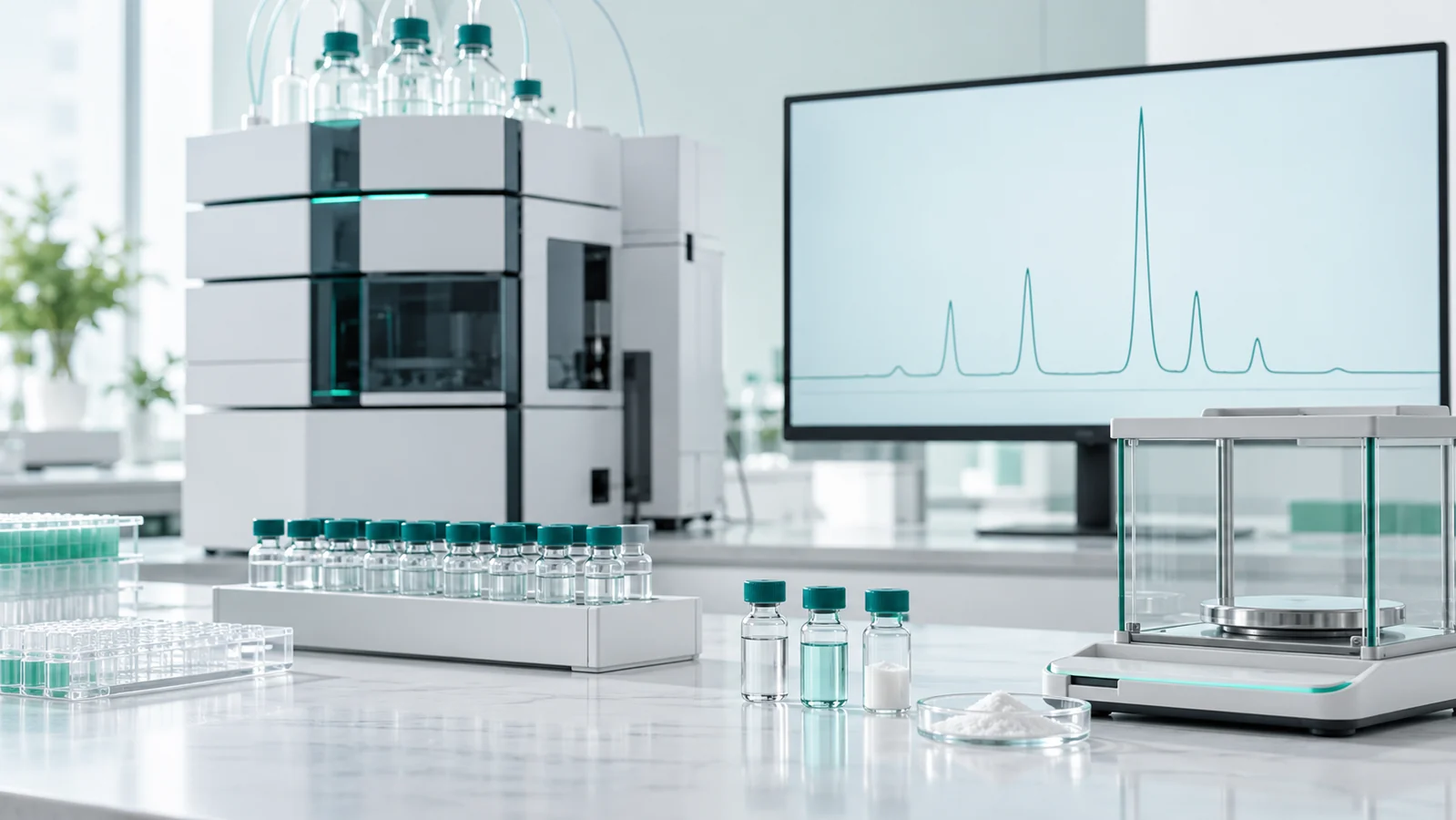
A 99% HPLC result does not mean a vial contains 99% peptide by mass or that its nominal fill is correct. HPLC area percentage describes the relative detector response of separated components under one method. Identity, quantitative peptide content, water, counterions and other non-peptide mass need their own evidence.
Purity and content answer different buyer questions
Chromatographic purity asks how much of the detected chromatographic response belongs to the main peptide peak. Quantitative content asks how much peptide is present in a stated mass of material or in a vial. Those questions overlap, but they are not interchangeable. A dry powder may contain peptide, associated counterions, residual water and other components that do not appear as equivalent peaks in a UV chromatogram. The review should therefore separate the method result from the commercial claim. Record the exact sample, lot, method, reporting basis and units for each number.
| COA attribute | Question it answers | What it does not prove |
|---|---|---|
| HPLC purity | Relative chromatographic profile under the stated method | Exact peptide mass, identity or vial fill |
| Mass spectrometry | Whether observed mass supports the expected molecular identity | Quantitative purity or total content by itself |
| Peptide assay or mass fraction | Amount of peptide on a defined basis | Absence of every process impurity |
| Water and counterion | Composition factors affecting gravimetric interpretation | Sequence identity or chromatographic purity |
Read HPLC area percentage within the method
HPLC separates components that interact differently with the stationary and mobile phases. The reported area percentage depends on sample preparation, column, gradient, detector wavelength, integration rules and the compounds that the detector can see. Co-eluting species may remain unresolved, while components with weak response at the selected wavelength can be underrepresented. A buyer should request the chromatogram, integration table, method reference and lot identifier, then check whether excluded or unidentified peaks are explained. Our HPLC and MS guide covers this evidence chain in more detail.
Area normalization is not a gravimetric assay
Area normalization divides the main-peak response by the total integrated response. It does not weigh the peptide. Different substances can have different detector responses, and water or inorganic residues may not be represented in the same way. Treat an HPLC percentage as a method-bound chromatographic result. If the purchase specification requires a quantitative amount per vial or per gram, name a suitable assay, its calculation basis and its acceptance criteria separately.
Account for water, salts and counterions
Synthetic peptides are commonly isolated as salts, and trifluoroacetate or acetate may be associated with charged sites. Water can also contribute to the measured material mass. The open-access review by Li and colleagues recommends distinguishing identity, purity, peptide concentration or mass fraction, residual solvents or water, and counterions during peptide quality control. A COA should state the reported form and avoid silently treating gross powder mass as net peptide mass. Where counterion exchange is requested, define both the target form and the method used to confirm it.
Build a mass-balance question before ordering
A practical RFQ asks how the supplier connects nominal fill, peptide assay, moisture and counterion results. The answer may be product-specific and does not have to sum to exactly 100% when methods, uncertainty and reporting bases differ. What matters is traceable logic. Ask whether results are reported as-is, on a dry basis or on an anhydrous and counterion-free basis. For a quantitative reference material, amino-acid analysis after hydrolysis can provide an independent amount assignment when properly designed, as discussed in Clinical Chemistry recommendations for mass-spectrometry peptide standards.
- State whether the purchase claim is gross material, net peptide or amount per finished vial.
- Request batch-specific HPLC and identity records, not a representative percentage alone.
- Define water and counterion reporting when they can affect the calculation.
- Reconcile the COA, label, quotation and analytical attachments to the same lot.
- Record uncertainty or method limitations instead of converting unlike results into one number.
Quality control and documentation for wholesale release
Put the attribute, method, unit, acceptance criterion and required record into the purchase specification. Review the actual lot package before shipment and preserve it with receiving records. The quality-control framework, documentation overview and lot traceability checklist provide the surrounding controls. For a current product and document discussion, see the Semaglutide 10mg research listing; availability and test scope must still be confirmed for the offered batch.
References
- HPLC Analysis and Purification of Peptides, Current Protocols in Protein Science.
- Role of Counter-Ions in Peptides, Molecules.
- Recommendations for peptide generation and quantification in mass-spectrometry assays, Clinical Chemistry.
Related products and quality-control reading
Review Semaglutide 10mg research material for a current catalog reference. Availability, specification and document scope are confirmed for each quotation and batch.
- HPLC and MS Tests for Research Peptides
- COA and SDS Documents for Peptide Import
- Third-Party Peptide Testing Buyer Guide
Frequently asked questions
Does 99% HPLC purity mean 99% peptide content?
No. It is generally a relative chromatographic result under a stated method. Quantitative peptide content needs a suitable assay and a clear reporting basis.
Can mass spectrometry confirm peptide purity?
Mass spectrometry can support molecular identity and reveal some related species, but a mass result alone is not a quantitative purity measurement.
Why do counterions matter on a peptide COA?
Counterions are part of the isolated salt form and can contribute to material mass. The reported form and measurement basis affect how a gravimetric claim is interpreted.
What should a wholesale buyer request?
Request the lot-specific COA, chromatogram and integration, identity evidence, quantitative content basis, relevant water or counterion results, labels and traceable lot references.
Editorial scope: Prepared from the cited primary and peer-reviewed sources for research procurement education. Regulatory references are interpretive frameworks, not a claim that every RUO material is approved for a regulated use.
Request a wholesale research peptide quote
Send the product or sequence, quantity, target specification, packaging, destination and required records. We will identify the information needed for a comparable B2B quotation.
Request Wholesale Quote